Alejandrina (trans. from Spanish)
Michael T. Dabrowski, 2020 CC BY-SA
After some thirty minutes on the sand dune, the breeze finally pierced her light cotton clothing and she felt a shiver run through her. Not quite ready to go back inside, her eyes fixed on the stars that painted the Milky Way, her thoughts drifted through the historical twists and turns that had brought her here.
Her mother had been a lover of classical French literature and named her after the alexandrine poetic verse, first used in the medieval epic Le Pèlerinage de Charlemagne, which recounts a fictional expedition of Charlemagne and his knights to Jerusalem and Constantinople. Ironic that her entire life had become a true expedition toward an unknown future. Her mother shared Charlemagne’s obsession with education and, as a result, despite her aptitude for engineering, Alejandrina was compelled to study the liberal arts. According to her mother, it was to complete her as a human being. She did not understand this until years after her mother’s death, when she finally decided which path to take in life. In a way, she was following in the footsteps of Charlemagne, who expanded the Frankish realms into an empire incorporating much of Western and Central Europe, becoming the metaphorical “Father of Europe.” If only her mother had known how prophetic her name would be, and how subtle its nuances.
It was in the mid–twenty-first century that the world changed, not because of the usual disruptions such as war, petty disputes among politicians, business magnates, religious leaders, or those who saw the world only in binaries, but through a submicroscopic infectious agent that replicates solely within the living cells of a host organism, in this case the human body. Earlier outbreaks such as H7N7 in 2003, which killed one person; H9N2 in 1999; H10N7 in 2004, both of which caused illness in children associated with poultry farms; and COVID-19, which claimed more than twenty million lives between 2019 and 2021, the year the vaccine was developed, had been warnings of what was to come. We believed the legacy of the 2019 pandemic would be world peace, that humanity would recognize “all together” as the motto of our planet. Yet barely two and a half years passed before another regional war erupted in the Middle East and apocalyptic cults and leaders resurfaced, peddling fear to expand their power and personal wealth.
It was a convergence of population density, forest erosion, and a pervasive disregard for surrounding wildlife that created the ideal conditions for a virus to jump from squirrels to humans. The virus of 2048, dubbed “Scrat-Flu” after the squirrel in Disney’s Ice Age films, infamously responsible for multiple global calamities, was a highly infectious global disease with a high mortality rate among both the young and the elderly. The middle generation was left in the sadistic position of mourning parents and children simultaneously. Those under twenty-five and the elderly were particularly affected, and the death toll approached two billion. The world ceased publishing the numbers; they were too demoralizing for the survivors. The loss of twenty-three percent of the global population shook the international financial system to its core, resulting in its complete collapse. The wealthy found themselves without money, and the disease leveled the social and economic divisions that had stratified humanity for millennia.
Alejandrina was born into this post-viral world. Older children often mocked her at school as a “boredom baby.” Social distancing had confined the global population indoors, and even the modest outdoor walks of 2019 disappeared due to the extreme contagion of the 2048 virus. Robots and drones provided essential services to the surviving population. Despite an almost limitless supply of television programs, holograms, and virtual reality escapes, people confined to small living quarters chose to procreate rather than descend into madness. Perhaps she was the product of a spark of hope that life would continue into an uncertain future. At least that is how she chose to imagine her parents struggling against an invisible enemy that had taken the two siblings she never met and three of her four grandparents before they even reached old age.
Her memories of youth were vague, except for the sadness her parents felt for her childhood in a collapsing world with little hope of improvement, and for her father’s death when she was ten.
Since the beginning of the Industrial Revolution, our way of life and the global climate had been on a collision course. In addition to the profound consequences of the 2048 health crisis, the cumulative effects of two or three centuries of selfish misjudgments began to reverberate worldwide, reaching a critical threshold around the same time as the pandemic. As global temperatures rose, the climate destabilized, sea levels climbed, and the ground shifted beneath our feet. Living on Earth became increasingly precarious.
She was a child of global upheaval. Her parents argued endlessly about how much harder life would be for her, stripped of most childhood luxuries: food shortages, few toys, minimal social contact with peers, and an absence of innocence. For those born before the pandemic, the shift from comfort to survival was wrenching. For Alejandrina, solitude and scarcity were normal, the only life she knew. Her parents pushed her to learn as much as possible. After her father’s death, her mother ensured that she devoted the bulk of her energy to education. She excelled in every subject, but it was in her mother’s library of world literature that she glimpsed what life had once been, and the beauty humanity had been capable of creating. Globally, despite cascading tragedies, education had been preserved at all costs. She seized this opportunity, recognizing that knowledge and wisdom contained in books were the only means to rebuild civilization.
The tremors felt in northwestern North America in 2019 were early indicators of seismic activity but were dismissed as isolated tectonic adjustments. Meanwhile, the push for U.S. energy independence spurred massive investments in hydraulic fracturing, undermining geological substructures throughout the Midwest. The land began to sink; aquifers shifted; subterranean voids produced instability that ultimately triggered the eruption of the Yellowstone supervolcano, as fresh magma flowed into the caldera reservoir as it had 2.1 million, 1.3 million, and 640,000 years before. The eruption at the Wyoming-Montana-Idaho border obliterated cities such as Idaho Falls, Butte, Bozeman, and Billings. Globally, ash rose into the upper atmosphere, accelerating the greenhouse effect.
By the early twentieth century, many nations had acknowledged the necessity of climate adaptation plans. The Netherlands, for example, invested in vast infrastructure to fortify the country against rising waters. Yet by mid-century it became painfully clear that only mass evacuations would prevent populations from sharing Atlantis’s fate.
Island nations likewise faced forced international migration as seas rose, intensifying anti-immigrant sentiment worldwide. By the time of the pandemic, rising seas had displaced nearly five hundred million people. Humanity had anticipated a one-to-three-meter sea-level rise during the twenty-first century, but had not factored a supervolcano into the equation. The compounded greenhouse effect melted ice sheets in Canada, Greenland, Russia, and much of Antarctica, doubling projected sea-level increases and driving most coastal populations inland.
Deforestation across the twentieth and twenty-first centuries nearly obliterated the Amazon rainforest. Scientists warned of agricultural logging, but economic forces overrode science. The tipping point arrived in 2028 when sufficient deforestation disrupted rainfall. A rainforest depends upon rain, and, as we now know, the forest generated its own ecosystem. Once the cycle broke through industrial monoculture and excessive clearing, the rainforest withered. Efforts to reverse the damage failed, and the Amazon basin devolved into grasslands and desert ecosystems. As a young adult nearly fifty years later, Alejandrina spent time in the region during her planetary engineering studies, exploring terraforming solutions to rebuild the planet’s lungs. Leading scientists estimated it would require fifty to sixty years of intense agricultural and meteorological intervention to restore a self-sustaining rainforest. Similar projects were underway in the Sahara, Australia’s Great Victoria Desert, and the Atacama and Patagonian deserts. Perhaps in a century or two humanity might return to clear skies and clean air.
When her mother gave her that name, she had never heard of the Dutch explorer Alexandrine Tinné, the first woman to attempt crossing the Sahara. Both lost their fathers at ten. Learning about Tinné in anthropology class, Alejandrina felt a strong connection to the ethnographer who documented and preserved Sudanese cultures in the nineteenth century. Through fate’s strange convergence, the name was more fitting than ever. She would preserve humanity for posterity, provided she did not meet the same fate as her namesake, who was murdered in the Sahara, bleeding slowly to death.
Sitting on the sand, gazing at the silver band of the Milky Way and the innumerable galaxies and nebulae illuminating the sky, she remembered her physics professor, accused by many of youthful psychedelic excess, who explained how the universe began with the Big Bang, composed initially of hydrogen and helium. Stars formed; within them, heavier elements such as carbon, oxygen, calcium, and iron were forged. At the end of their lives, some stars exploded as supernovae, the primary mechanism of chemical enrichment in the universe and the basis for planets, life, and humanity. He traced human genetic origins to mitochondrial Eves in Africa, and further back, the atoms in our DNA to ancient supernovae. The universe, he insisted, was our cosmic mother. Social distancing after 2021 intensified technological isolation. In a society where neighbors did not know one another, the sense of unity eroded, until the 2048 pandemic reminded us how fragile life is and how profound a privilege it is to be alive. With that realization came an awareness of our cosmic obligation to a universe that had created the conditions for life to emerge and evolve toward self-awareness. The United Nations seized this fragile moment of global solidarity to launch its boldest initiative to preserve human life.
Looking at the stars and recalling her cosmic origins, Alejandrina thought again of her mother and the name she had given her: a poetic verse, an explorer of uninhabited lands, and, unintentionally, a name meaning “defender of humanity.”
Defender of humanity, she reflected, smiling. What a prophecy.
Abruptly she returned to the present. She sat upright, scooped a handful of sand, lifted her hand, and let it trickle between her fingers. She drew three deep breaths of air, dry as Tinné’s desert. It was time. She rose, brushed the sand from her clothes, cast one last glance at the vast Milky Way, and descended the dune toward the doorway that opened to her future. She keyed in the codes to seal the desert dome and set the environmental controls to automatic. Automated systems would preserve Tinné’s ecosystem for a long time.
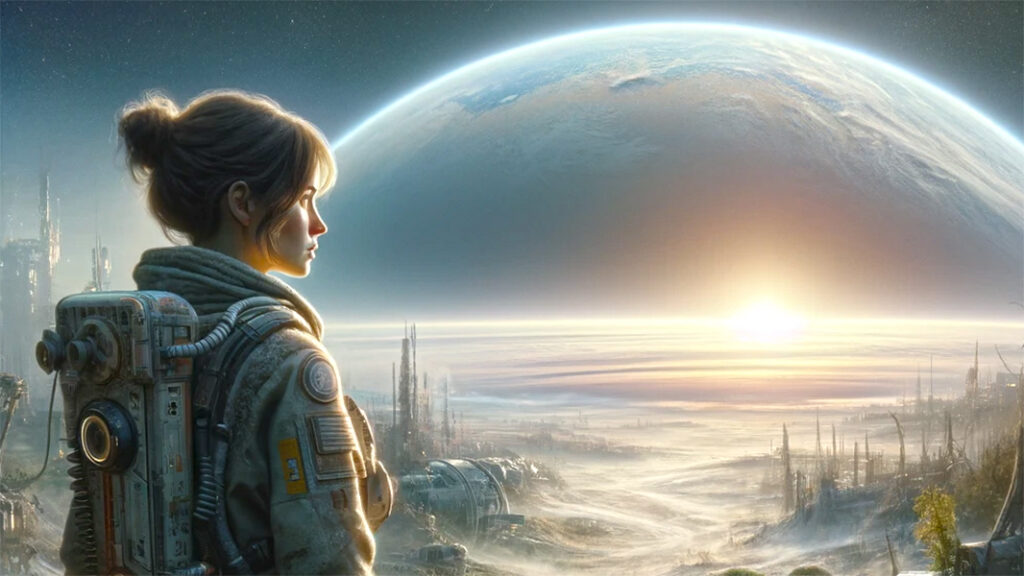
Unhurried, she verified the readings, ensuring all settings were within normal parameters, and pressed “Initiate Sequence.” She lay down and closed the star-studded dome above her, thanking her cosmic mother for the chance to live. In minutes she would sleep, encased in a carbon-monofilament cocoon. It would be the sleep of a lifetime, or two, and herald a profound transformation. As commander of the colony ship UNSS Wolverine, traveling fourteen light-years to a new home, Alejandrina would be the first to awaken from cryogenic suspension in just under one hundred eighty years to prepare orbital insertion around a habitable planet circling the red dwarf Wolf 1061, discovered in 2015 at La Silla Observatory in Chile. Like her counterparts aboard United Nations vessels bound for Proxima Centauri, Lacaille 9352, Tau Ceti, Luyten’s Star, and Gliese 832, she would, upon arrival, be responsible for sowing humanity among the stars, a contingency plan for the only known spacefaring species in the universe, one regrettably inclined toward self-destruction.