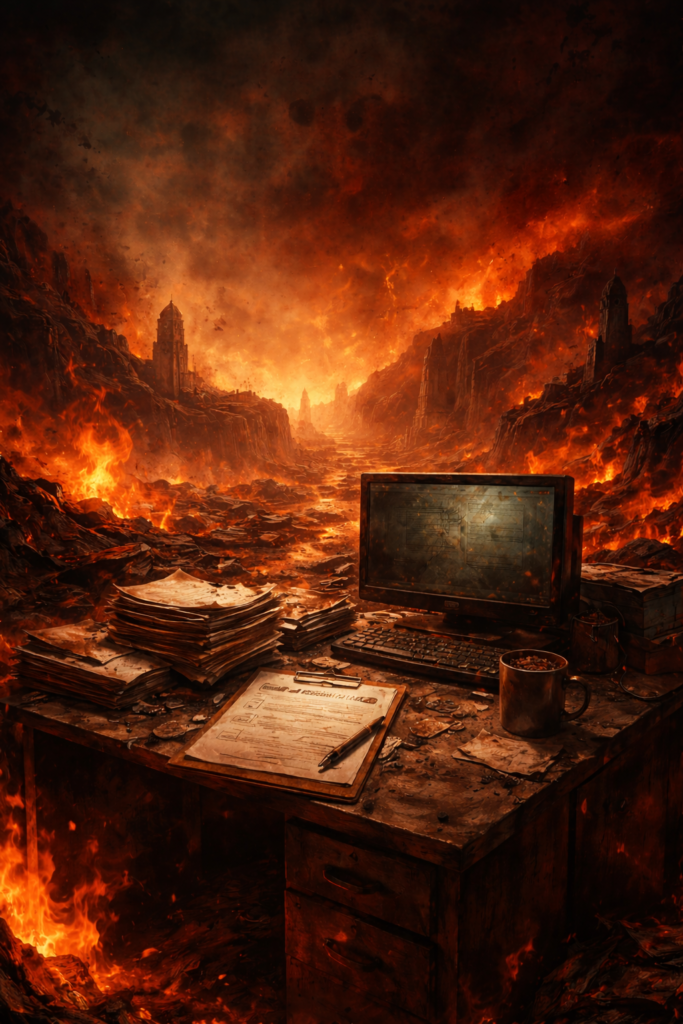
Without Morality or Consequences
Michael T. Dabrowski, 2026 CC BY-SA
For a long time, I believed Hell was simple. Flames, screams, a rudimentary moral order. An ancient craft: damnation as a trade. There was something almost comforting in its clarity. One knew what one had come for. Souls arrived, burned, and vanished. No relics remained. Only ash and heat, reducing suffering to elementary physics.
But even eternity deteriorates. Even punishment modernizes.
I don’t recall the precise moment when everything became administrative, but I do remember the first email. Because yes, Hell now has an inbox. The subject line read something like “Protocol Update,” and the contents spoke, with intolerable serenity, of sustainability. We were informed that human suffering must be aligned with contemporary standards, that unnecessary emissions were to be reduced, that damnation must become more responsible.
I read the message twice, expecting to find a hidden joke. There was none.
The following day a consultant appeared. Now, a consultant always appears. He wore an impeccable suit, a statistical smile, and that manner of speaking which converts the incomprehensible into a slide deck. He said that torment was fine, of course, but that we must ask ourselves whether it was scalable. He took notes when I explained that Hell, like Dante had envisioned, quite literally, has nine circles.
Since then, my work has ceased to consist solely in consuming souls. I must now manage them as well. Souls are categorized. Filed. Logged as though they were waste. There are forms: intake, repentance, energy potential. There are metrics. There is efficiency. Dense souls burn slowly, with steady combustion. Light ones evaporate quickly. Poets’ souls produce a dramatic flame but give off little heat. Accountants, by contrast, are perfect: constant, predictable, sparkless.
Politicians’ souls are another matter. They don’t ignite immediately. First, they smolder. They produce a disproportionate quantity of immoral smoke, a dirty combustion filled with broken promises and empty phrases. They are difficult souls: they resist consumption because they remain convinced, even down here, that they can still negotiate. Some arrive requesting a special commission, others demand a hearing, still others ask who authorized their condemnation.
When they finally burn, they generate no heat: they generate noise. They crackle like interminable speeches. And they leave residue. Thick, bureaucratic ash that must be swept carefully because it has a tendency to reorganize itself into small committees. For strictly technical reasons, therefore, politicians’ souls are stored separately and incinerated only under special protocols.
The worst are the modern souls. They arrive with questions. Is this permanent? Is there an appeals process? Where is the supervisor? Can I upgrade to a better circle?
Worse still, they arrive with expectations. Because now, in addition to everything else, we have satisfaction surveys. Each condemned soul must complete a form after its first thousand years.
“Please rate your infernal experience from 1 to 5.”
“Did the torment received meet your expectations?”
“Would you recommend this infernal circle to a friend or family member?”
Some respond with fury. Others with sarcasm. Most simply mark 3 with resignation.
Once I read a comment that said:
“The fire is adequate, but customer service is deficient. No one clearly explains why I am here.”
Another wrote:
“I expected more originality. Plenty of heat, but it’s all repetition: flames, screams, ash everywhere. One would think eternity would allow for something more creative.”
We file them, of course. Everything is filed. Eternity, at after all, is a storage system.
Sometimes they ask me what is a soul. Humans say essence, mystery, inner light. I would say something else: a metaphysical residue that burns. Something which, once reduced to fuel, loses its poetry and becomes infrastructure.
And therein lies what is truly unsettling. For Hell is not only punishment. Hell, this almost no one knows, has also been the planet’s thermal core.
For millions of years, our deep fire kept the Earth habitable. Life, in a sense, relied on us. Magma, tectonic plates, subterranean heat: all of it was part of the same system. Eternal damnation as geothermal energy.
We never asked for recognition. We were just a necessary evil. We maintained equilibrium.
But then humanity arrived. And humanity, with its admirable capacity to ruin even the metaphysical, began heating the world on its own. They burned forests, burned coal, burned oil as though competing with us. They produced a superficial, industrial Hell, devoid of elegance. The planet began to overheat. And suddenly we found ourselves in an absurd situation: the heat from below and the heat from above, accumulating, amplifying, creating a runaway greenhouse effect.
One day we received a report, stamped URGENT:
Risk of total planetary combustion.
I read it with discomfort, not fear, but professional humiliation.
Hell was contributing to climate collapse. We, the experts in heat, had become the problem. There were meetings. There were committees. There was a memorandum I never thought I would see:
Possible temporary closure of Hell.
Closure. As though eternity could be suspended for maintenance.
Then came a proposal worse still: to transform certain circles into permanent accommodations. Containment spaces. A Hell converted into residence, not from mercy, but from thermal necessity.
For if the Earth burned too intensely… nothing would remain.
No cities. No bodies. No souls!
The worst scenario was not eternal suffering. It was the extinction of the supply. Absolute nothingness: a scorched planet with no one left to condemn. Hell without fuel. We were running out of world to consume.
Gazing into the flames with an unpleasant lucidity, I understood that perhaps the true torment was not to burn, but something worse: to discover that even the eternal flames could become provisional. That damnation, suddenly, might depend upon an external decision, a thermal calculation, a planetary emergency. And now, worse still, the possibility of extinguishing Hell itself.
In that lucid moment, I finally understood that eternity is not that long, and that the perfect punishment is not the flames, but receiving an email that reads:
| Dear all, In order to guarantee the continuity of the planet, the condemnation of souls has been suspended until further notice. [ ] Please check this box if you understand that good and evil are hereby eliminated. We apologize for any inconvenience. |
A Note to Readers
This story was created with the support of generative artificial intelligence, which I use as a creative assistant in much the same way a contemporary writer employs digital tools to draft and revise. I believe that technology, when used thoughtfully, can help us write with greater freedom, explore ideas more rapidly, and devote more time to shaping what truly matters: the story itself.
All final content and responsibility for the text remain entirely my own, and I hope you enjoy the work for what it is.